Getting Ready for the Virginia CDL Backing Test
After the pre-trip inspection, the next part of the Class A CDL skills test is the CDL backing test. This guide covers each exercise, the scoring rules, and step-by-step tips for straight line and offset backing.
What Is the CDL Backing Test?
The CDL backing test is the second part of the Virginia CDL skills test, and its official name is the basic control skills test. Drivers complete four exercises: forward stop, straight line backing, forward offset tracking, and reverse offset backing. The examiner scores encroachments, pull-ups, looks, and final position.
The backing test comes between the pre-trip inspection and the on-road driving test, which together make up the three-part CDL skills test. It checks whether a driver can control a truck at low speed and judge where it sits next to lines and cones.
Drivers must pass each part in order, so a driver who fails the backing test cannot take the road test. The exercises may take place on an off-road course or on the street during the road test.
What Backing Maneuvers Are on the Virginia CDL Test?
Virginia’s Commercial Driver’s License Manual uses a national test created by the American Association of Motor Vehicle Administrators (AAMVA). The four exercises are:
- Forward stop: The driver pulls forward through an alley of cones and stops with the front of the truck inside a box at the end. Only one stop is allowed.
- Straight line backing: The driver backs straight through the alley until the front of the truck clears the last set of cones.
- Forward offset tracking: The driver pulls forward and steers left into the next lane. The right rear tire must stay between the cones and the line.
- Reverse offset backing: The driver backs from the left lane into the right alley. The truck must end up straight, with its rear inside a 3-foot box at the end of the alley.
The two backing exercises take the most practice, so the step-by-step sections below focus on those.
Is the Alley Dock Still on the CDL Test?
No, not in Virginia. The older CDL skills test used a mix of straight line backing, offset backing, parallel parking, and the 90-degree alley dock. The modernized test replaced parallel parking and the alley dock with the four exercises listed above, on a smaller course.
The alley dock still matters on the job. Many drivers back into loading docks as part of their daily work, and the same skills apply: back slowly, turn toward the driver’s side when possible, and get out and look when unsure.
How Is the Backing Test Scored?
The examiner watches for four things:
- Encroachments: Touching or crossing a cone or boundary line with any part of the truck except the mirrors. Each one counts as an error.
- Pull-ups: Stopping and pulling forward during a backing exercise to fix the truck’s position.
- Looks: Opening the door or leaving the seat to check the truck’s position. Drivers often call this a GOAL, short for “get out and look.”
- Final position: Where the truck ends up. A truck that does not finish where the examiner said fails the whole backing test.
Some pull-ups and looks are free. The table shows what each exercise allows.
| Exercise | Free pull-ups | Free looks |
|---|---|---|
| Forward stop | None (one stop only) | None |
| Straight line backing | 1 | 1 |
| Forward offset tracking | None (no back-ups) | None |
| Reverse offset backing | 2 | 2 |
Before any look, the driver must set the parking brake, shift to neutral, and climb out facing the truck with three points of contact. Skipping any of these steps can count as an unsafe act and an automatic failure.
How to Do Straight Line Backing
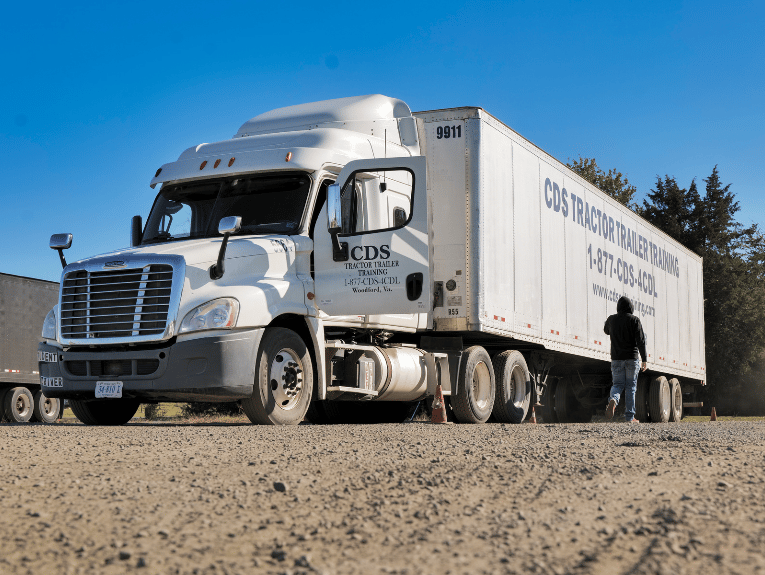
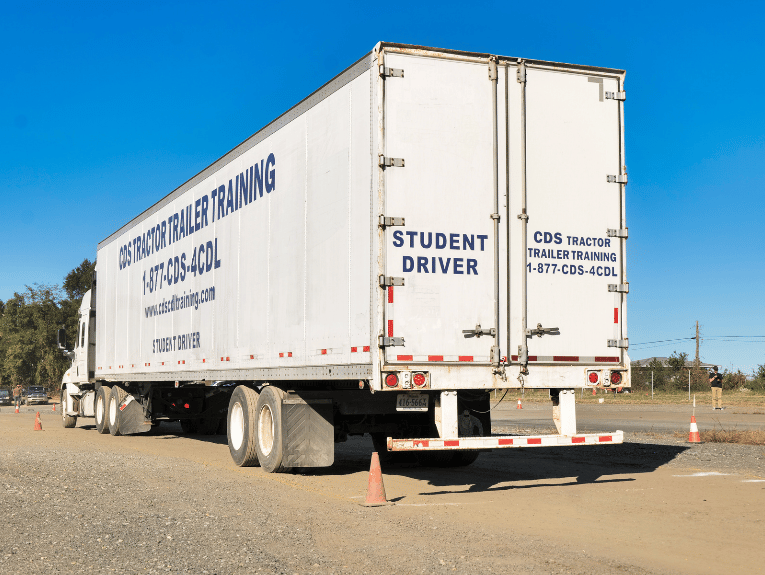
Straight line backing means backing a tractor-trailer through a straight alley of cones until the front of the truck clears the last cones. The trailer starts to drift as soon as the truck moves, so the goal is to catch drift early and fix it with small moves.
Step 1: Pull Forward Straight
The examiner will ask the driver to pull forward and stop. The truck and trailer should be lined up straight before backing starts. A straight start makes the rest of the exercise much easier.
Step 2: Check Both Mirrors
Both sides of the trailer should look the same in the left and right mirrors. Drivers should also roll down the window and check that the area behind the truck is clear.
Step 3: Back Slowly
Drivers should use the lowest reverse gear and back at idle speed without pressing the gas. Slow backing gives the driver time to see drift and correct it.
Step 4: Make Small Corrections
If more of the trailer shows in one mirror, the trailer is drifting toward that side. The driver should turn the wheel a small amount toward that mirror, then straighten the wheel as soon as the trailer lines up again. Big turns cause the trailer to swing back and forth. If the driver is unsure where the trailer is, using the free GOAL is better than guessing.
Step 5: Finish and Signal
The driver keeps backing until the front of the truck clears the last set of cones. Then the driver sets the parking brake, shifts to neutral, and sounds the horn so the examiner can score the final position.
How to Do Offset Backing
Offset backing means backing a trailer from one lane into a lane next to it. On the Virginia test, this is the reverse offset backing exercise. The driver starts in the left lane and backs into the right alley, which means backing toward the passenger side.
This is called blind side backing, since the driver cannot see that side of the trailer by turning around. The right mirror does most of the work, so the free looks matter more here.
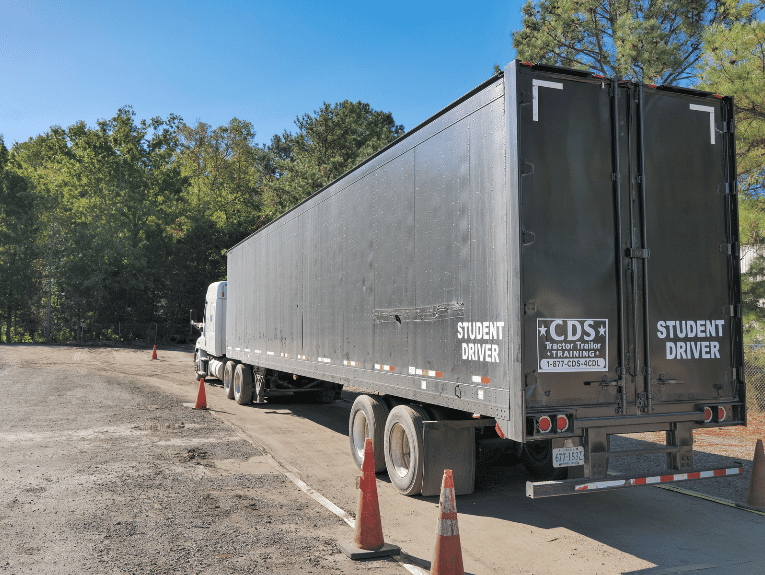
Step 1: Start Parallel
The truck should sit straight and parallel with the outer boundary line. The examiner will point out the rear-most part of the trailer, since that part has to end up in the 3-foot box.
Step 2: Start the Trailer Turning
A simple rule helps here: with one hand on the bottom of the steering wheel, move the hand in the direction the trailer should go. To send the trailer to the right, the driver moves that hand to the right. The trailer will start to angle toward the right alley.
Step 3: Follow the Trailer
Once the trailer is angled into the alley, the driver turns the wheel the other way. This brings the tractor around behind the trailer so the whole truck lines up in the alley. Waiting too long here can cause a jackknife, where the trailer folds too sharply against the tractor. Fixing it usually takes a pull-up.
Step 4: Straighten and Use Looks Wisely
With the truck lined up, the driver straightens the wheel and backs straight. Many students save one GOAL for when the trailer enters the alley and one for the end, when judging the 3-foot box is hardest.
Step 5: Stop in the Box
The truck must be straight, fully inside the boundary lines, and stopped with its rear inside the 3-foot box. The driver then sets the parking brake, shifts to neutral, and sounds the horn.
Common Backing Test Mistakes
- Backing too fast. Speed turns a small drift into an encroachment before the driver can fix it.
- Large turns make the trailer swing from side to side. Small turns and quick returns to center work better.
- Using GOALs too early. A driver who uses both looks early has nothing left for the end of the exercise, where judging the box is hardest.
- Exiting the cab the wrong way. Leaving without setting the parking brake or without three points of contact can end the test.
- Not finishing the exercise. A truck that stops short of the last cones or outside the box fails the backing test, even with no other errors.
- Guessing at instructions. Drivers who are unsure what the examiner wants should ask before starting.
How Does CDS Prepare Students for the Backing Test?
CDS Tractor Trailer Training students practice each backing exercise on a cone course at the four Virginia training centers as part of Class A CDL training. Instructors work with students on setup, mirror use, and small corrections until they can finish each exercise without help. Students also learn when to use a look and how to exit the cab safely.
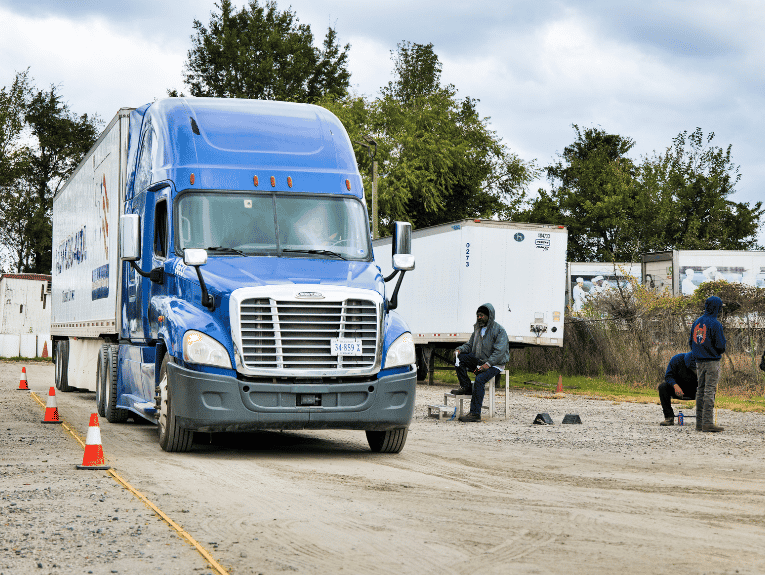
Federal Entry-Level Driver Training rules also require hands-on range practice, including backing. New drivers must finish this training before they can take the skills test.
Current CDL holders who want more backing practice can sign up for the CDL Refresher Course. Help with the cost of training may be available through tuition assistance. To get started, request more info or call (844) 654-2235.
Frequently Asked Questions
Does stopping during a backing exercise count as a pull-up?
No. A pull-up only counts when the driver stops and pulls forward.
Can a driver ask to walk through the backing course first?
Sometimes. Drivers may ask, but the examiner decides whether to allow a walk-through of the course.
Can a driver choose which side to do offset backing on?
No. The examiner sets up the exercise, and the driver must complete it as directed.
Is the backing test the same for a Class B CDL?
Yes. Class B drivers take the same four exercises in the vehicle they use for the test.
What happens if a driver uses more than the free pull-ups?
Each extra pull-up counts against the driver’s score. Too many errors can fail the backing test.