Nearly seven in ten U.S. professionals changed careers, or thought about it, in the past year. That number comes from a FlexJobs survey of 2,293 workers, published March 7, 2025. One in three workers said they had quit a job, or thought about quitting, in the six months before that. This kind of restlessness shows up in almost every industry, and trucking is one of the places where workers are landing. Part of the draw is the Commercial Driver’s License (CDL) itself, as a CDL opens the door to a job with a stable salary after weeks of training, not years.
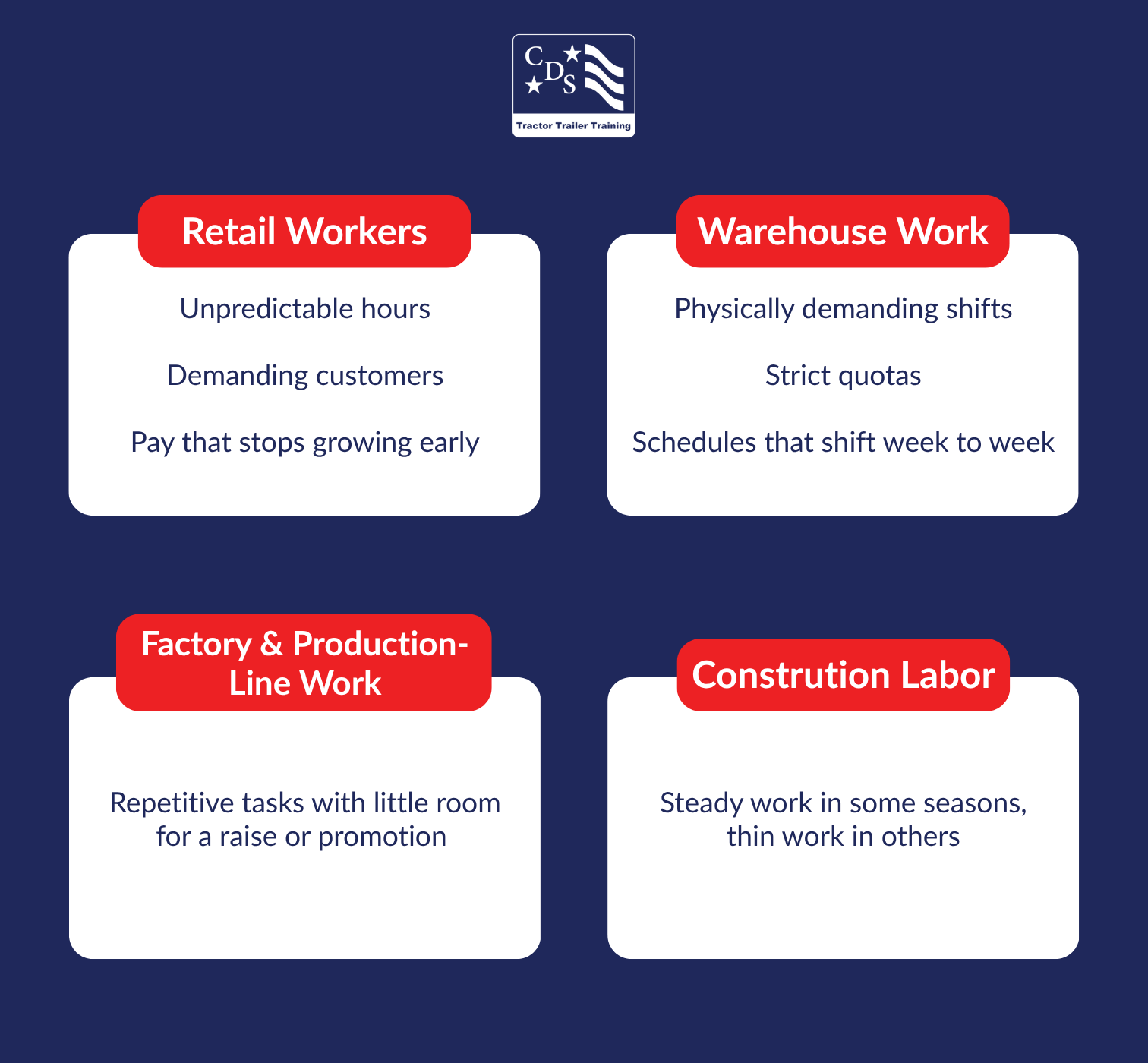
Retail, Warehouse, and Factory Workers Are Leading the Shift
The FlexJobs survey number covers career switching in general, not trucking specifically, and no single survey tracks exactly how many people move into the industry each year. Still, it matches a pattern that CDL schools and trade groups see up close. People rarely leave a job on a whim: pay stops growing, the job stops feeling secure, and there is no clear path up. That pattern shows up most often among frontline workers, and trucking keeps coming up as the next step, mainly because it skips the college degree and years of retraining that other career changes require.
Many drivers come from teaching, office work, restaurants, hotels, factories, warehouses, or the military. For trucking, they need a CDL, not a 4-year degree. Most people can earn one in a matter of weeks. That fast path only makes sense if the jobs are there once training ends, which is the part worth checking first.
Is There Really a Truck Driver Shortage?
Most industry data points to a real shortage of truck drivers. The American Trucking Associations (ATA) has published shortage estimates for years, ranging from about 81,000 drivers short in 2021 to roughly 60,000 more recently. The Bureau of Labor Statistics (BLS) backs that up with its own number: an average of 237,600 job openings per year for truck drivers through 2034, an estimate from its Occupational Outlook Handbook using May 2024 data. Most of that demand comes from drivers retiring or leaving the job rather than new freight. Either way, someone has to fill those seats every year, and carriers are competing for CDL graduates as soon as they finish training.
How Much Do New Truck Drivers Actually Make?
The median annual wage for truck drivers was $57,440 as of May 2024, per the same BLS handbook. That median covers every driver in the occupation, from entry-level pay to someone with twenty years behind the wheel, so it sits well above what a brand-new driver should expect on day one. Pay grows steadily from there as drivers gain experience, add endorsements, or haul specialized freight.
How Long Does CDL Training Take?
Four to eight weeks is the standard length for full-time CDL training with no prior experience. That range holds steady across the driving-school industry nationwide. Some accelerated programs finish in one to three weeks. Part-time and evening tracks, built around a current job, usually run three to six months. Compared to a two-year associate degree or a four-year bachelor’s degree, even the longer training paths move fast.
Pay and Training at a Glance
| Metric | Figure | Source |
|---|---|---|
| Median annual wage, all experience levels | $57,440 | BLS Occupational Outlook Handbook, May 2024 data |
| Annual job openings through 2034 | 237,600 average per year | BLS Occupational Outlook Handbook, May 2024 data |
| Standard full-time CDL training | 4–8 weeks | Industry-wide, current |
| Accelerated CDL training | 1–3 weeks | Industry-wide |
| Part-time or evening CDL training | 3–6 months | Industry-wide |
Ready to Make The Switch?
CDS Tractor Trailer Training trains new Class A and Class B CDL drivers at four Virginia campuses: Fredericksburg, Norfolk, Richmond, and Roanoke. Class A training runs as little as 20 days, or 160 hours, and prepares graduates for over-the-road and local driving jobs. Class B training runs 15 days, or 120 hours, at the Fredericksburg and Norfolk campuses only, and covers straight-truck and bus driving roles. Carriers recruit on campus throughout training, giving graduates hiring leads before they finish the program.
Anyone weighing a second career in trucking can call (844) 654-2235 to talk through options, or learn more about CDS’ CDL training programs.